
Table of Contents
- Understanding Your Legal Rights
- Threats Made on Your Phone (Telegraph Act)
- Harassment on Social Media (PECA/NCCIA)
- Face-to-Face Threats (Pakistan Penal Code)
- Stopping Online Abuse and Defamation
- Final Steps to Secure Justice
Understanding Your Legal Rights
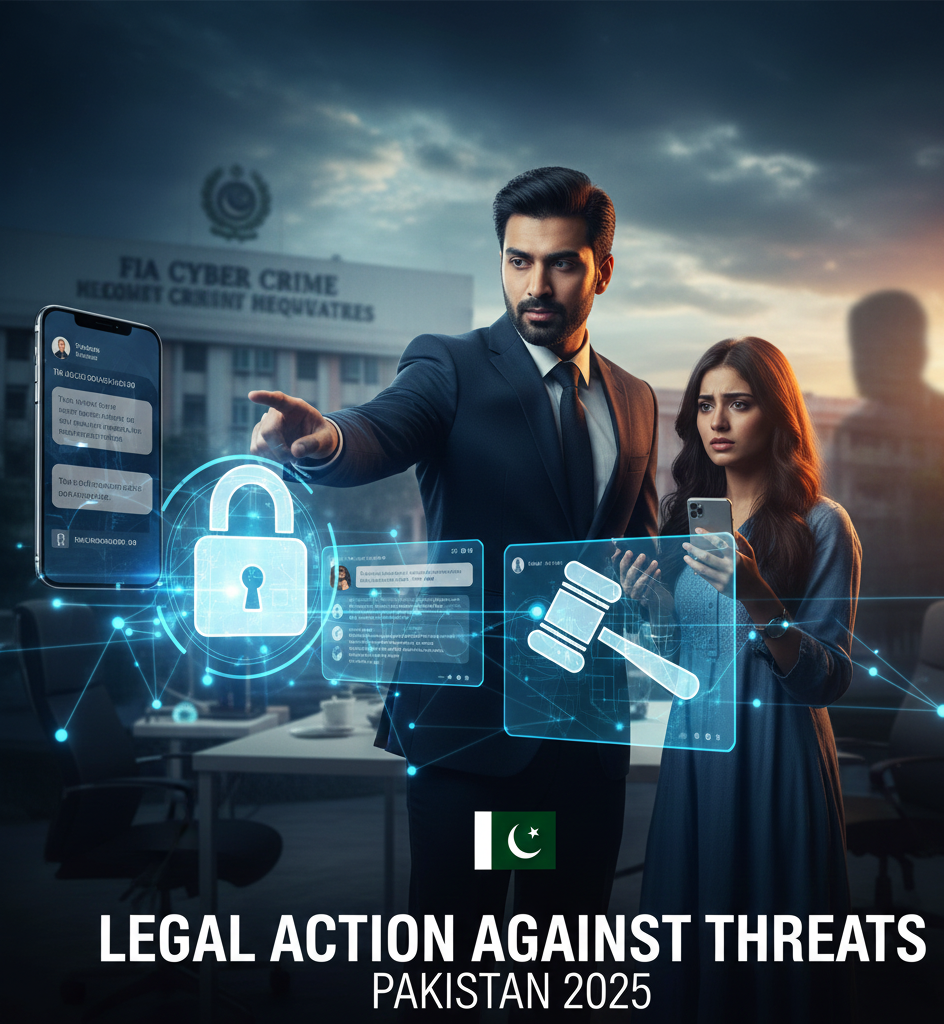
Many people in Pakistan now face the distressing problem of receiving threatening phone calls or finding abusive comments on social media. This situation creates immense fear and mental anguish. Fortunately, the law provides clear ways for you to fight back. Whether the harassment occurs digitally or in person, initiating Legal Action Against Threats ensures you protect your dignity and safety.
Threats Made on Your Phone (Telegraph Act)
If someone threatens you directly via a call or text message, you possess an immediate course of action. You can formally file an application under Section 25-D of the Telegraph Act at your local police station.
- Details to Include: State the phone number, the exact time of the call, and the content of the threat.
- Legal Consequence: This section deals with a non-bailable offense. The police must register a First Information Report (FIR) against the accused, initiating a strong criminal process.
Harassment on Social Media (PECA/NCCIA)
Threats on WhatsApp, Facebook, or Instagram fall under the Prevention of Electronic Crimes Act (PECA). As of 2025, the National Cyber Crime Investigation Agency (NCCIA) has taken over the specialized role previously held by the FIA’s Cyber Crime Wing. You can file a complaint online at the official NCCIA portal or visit their regional offices.
- Evidence Needed: Secure clear screenshots of the threats and abusive comments.
- The New 2025 Law: Recent amendments have increased punishments for digital harassment and established the Social Media Protection and Regulatory Authority to block offensive content within 24 hours of a report.
Face-to-Face Threats (Pakistan Penal Code)
When threats occur during a real-life interaction, you must use the Pakistan Penal Code (PPC). You can file a case at your local police station under Sections 506 and 506-B of the PPC.
- Crucial Tip: These cases typically require witnesses. Unlike digital threats where screenshots act as proof, physical threats rely on the testimony of people who saw the event.
Stopping Online Abuse and Defamation
Abusive language and false statements that damage your reputation constitute defamation. For this, you have two powerful options:
- Criminal Route: File a lawsuit under Sections 499 and 500 of the PPC.
- Civil Route: Under the Punjab Defamation Act 2024, you can approach a specialized tribunal to seek damages up to PKR 30 million. Even if you cannot prove actual financial loss, the law presumes “General Damages” if you prove the defamation occurred.
Final Steps to Secure Justice
Any form of abuse has a legal remedy. The most important step is to securely save all evidence.
- For phone threats: Keep call logs and messages.
- For online abuse: Take high-quality screenshots and note the profile URLs.
You have the full right to use these laws to hold offenders accountable. Do not let harassers intimidate you into silence.
For professional assistance with criminal law services and Legal Action Against Threats, contact:
BETTER CALL NOW Muhammad Amin, Advocate 📞 Phone: 0313-9708019 | 0335-1990495 📧 Email: muhammadaminadvo111@gmail.com 📍 Location: Peshawar