able of Contents
- The Meaning of the Supreme Court Decision
- When a Woman Earns Her Financial Support for Wives
- Why Judges Reject the Idea of Physical Obedience
- The Legal Right to Alimony Starts at the Wedding
- How the Constitution Protects Women’s Financial Protection in Marriage
- Legal Limits on Marital Financial Obligations
- The Power of Respectful Language in Family Courts
- Conclusion and Contact Information
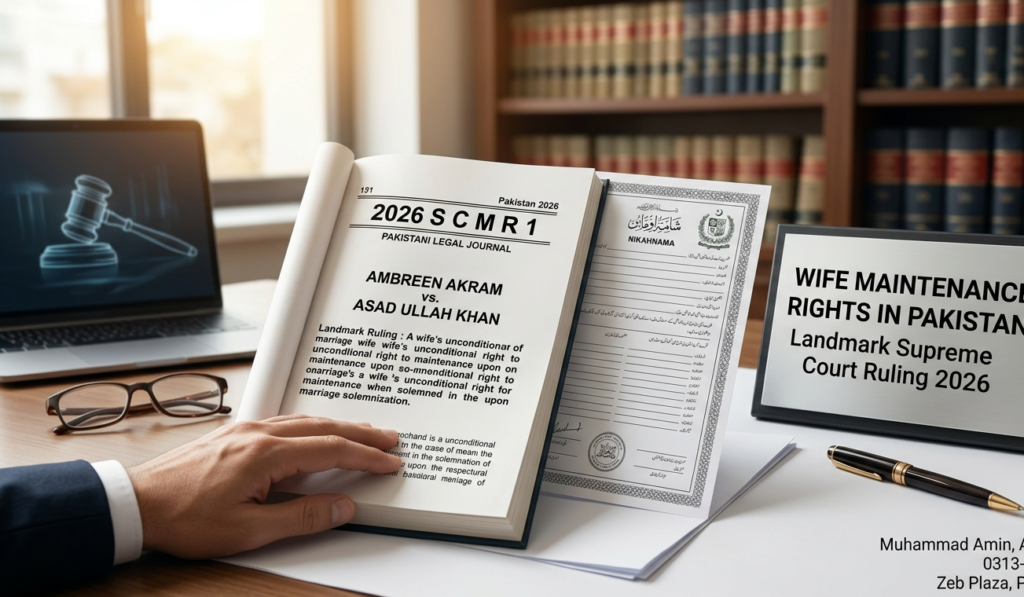
The Meaning of the Supreme Court Decision
The Supreme Court of Pakistan recently delivered a very important judgment in the case of Ambreen Akram. This ruling changes how courts look at wife maintenance rights in Pakistan forever. Before this, some people believed that a husband only owed his wife money after she moved into his house. The High Court originally stopped a woman from getting her money because her Rukhsati never happened. However, the Supreme Court stepped in to fix this mistake. The judges decided that a husband must support his wife as soon as they sign the Nikahnama. This decision marks a huge win for fairness and justice in the country.
When a Woman Earns Her Financial Support for Wives
The court explains that marriage acts as a sacred social contract between two people. Therefore, the husband takes on the duty to provide financial support for wives the moment the ceremony ends. A woman does not need to prove that she lived with her husband to ask for her basic needs. The law sees the marriage contract as the only proof she needs. If the marriage is valid, then the right to money is also valid. This rule ensures that men cannot use delays in Rukhsati to avoid their responsibilities.
Why Judges Reject the Idea of Physical Obedience
In the past, some legal experts argued that a wife only gets money if she obeys her husband physically. The Supreme Court now completely rejects this old way of thinking. It describes the legal right to alimony as something that comes from love and mercy rather than power. The judges state that marriage is not a trade where a woman gives up her freedom for food. Instead, it is a partnership of equals who respect each other. This modern view removes the pressure on women to submit just to survive financially.
The Legal Right to Alimony Starts at the Wedding
The judges looked closely at the Muslim Family Laws Ordinance of 1961 to make their point. They found that the law gives a wife the legal right to alimony immediately after the wedding. The law does not mention Rukhsati or living together as a requirement for support. Consequently, any husband who neglects his wife’s needs breaks the law. Even if the couple never lives in the same house, the husband must pay for her daily expenses. This protection stays in place until the marriage officially ends through divorce.
How the Constitution Protects Women’s Financial Protection in Marriage
The Supreme Court also used the Constitution of Pakistan to support its choice. The Constitution promises to protect the dignity and equality of every citizen. Thus, providing women’s financial protection in marriage fulfills this constitutional promise. When a court denies a woman her money, it hurts her dignity and makes her vulnerable. The judges believe that the law must act as a shield for women against economic hardship. By enforcing these rules, the court ensures that every woman feels safe and respected within her legal union.
Legal Limits on Marital Financial Obligations
The court clarifies that a husband can only stop paying if he proves his wife truly abandoned the relationship. However, the husband carries the heavy burden of proof in these situations. He must show clear evidence that his wife refused to live with him for no good reason. If the husband fails to provide a safe home or pay the dower, the wife has every right to stay away. In such cases, the husband must still fulfill his marital financial obligations without excuse. The law protects the wife if the husband is the one causing the delay or problems.
The Power of Respectful Language in Family Courts
Finally, the Supreme Court gave advice to all lower court judges about the words they use. It asked them to stop using words like surrender or submit when talking about wives. These words belong to the past and do not fit a modern society. Instead, judges should use language that promotes equality and mutual respect. Proper words help change how society views the role of women in families. Every judgment should reflect the fact that a woman is a full and autonomous person with her own rights.
Conclusion and Contact Information
This ruling brings a bright future for women across Pakistan by securing their financial safety. It proves that the law values the marriage contract above cultural traditions or unfair demands. If you need help with these matters, you should talk to a professional legal expert.
For professional assistance with law services and related legal matters, contact:
Muhammad Amin, Advocate Phone: 03139708019 Email: muhammadaminadvo111@gmail.com Office: Office No. 14, Zeb Plaza, University Road, Tahkal Payan, Peshawar