The Superior Power of Civil Courts
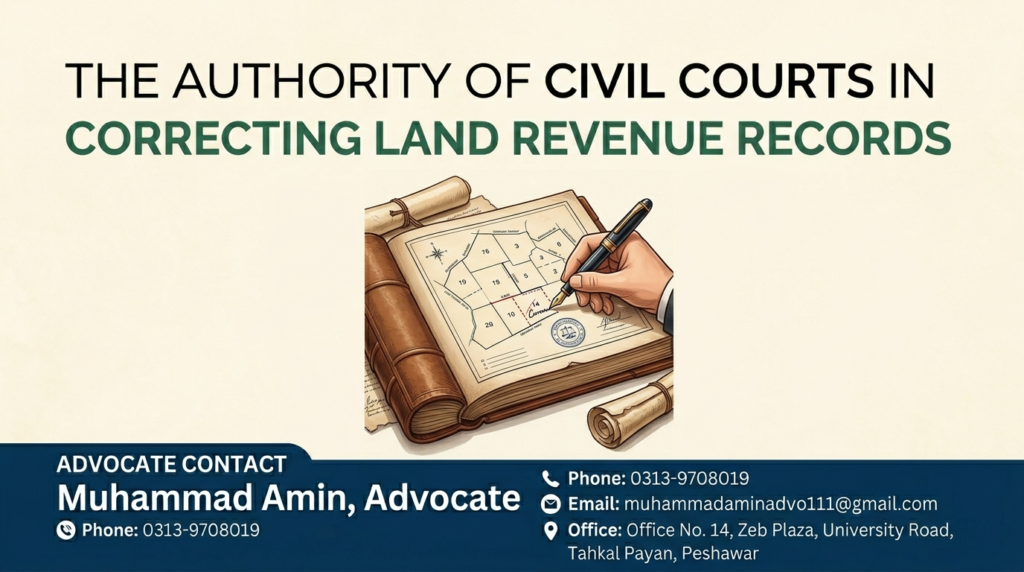
Legal disputes regarding land often create confusion about which forum a person should approach. Many people believe that only revenue officers can change or correct land records. However, the law provides a much broader scope for individuals to protect their property. When a person faces an illegal transfer of their land, they possess the right to challenge that action in a Civil Court. The Civil Court acts as the court of ultimate jurisdiction. This means it holds the final power to decide complex questions about ownership and title. Even if a government department transfers land into its own name without notice, the aggrieved owner can seek justice through a civil lawsuit.
Understanding Section 53 of the Land Revenue Act
The Balochistan Land Revenue Act contains specific provisions that protect the rights of landholders. Specifically, Section 53 serves as a vital tool for anyone who feels unhappy with an entry in the record-of-rights. This law explicitly allows a person to file a suit for declaration under the Specific Relief Act. Some lower courts occasionally misunderstand this provision by suggesting that people must only use revenue channels. However, the High Court has clarified that Section 53 actually encourages the use of Civil Courts. This section ensures that any person who stays in possession of a property can ask a judge to declare their true legal status. Therefore, the law does not bar a citizen from seeking help from a civil judge.
Why Revenue Entries Do Not Prove Ownership
A very important legal principle exists regarding revenue documents like mutations or “Inteqals.” These entries in the revenue record do not serve as absolute proof of title by themselves. They primarily exist for fiscal purposes, such as collecting taxes. If a party claims they own a piece of land, they must prove that ownership independently through solid evidence. The mere fact that a government official wrote a name in a register does not make that person the permanent owner. Because these entries are not final proof, the Civil Court remains the only proper place to determine who actually owns the land through inheritance or purchase.
The Right to Fair Trial and Due Process
The Constitution of Pakistan protects every citizen through Article 10-A. This article guarantees the right to a fair trial and due process for the determination of civil rights. When a court dismisses a case without looking at the actual facts or by misinterpreting the law, it violates this constitutional guarantee. In many instances, authorities transfer land without giving the owner a proper notice or a chance to speak. Such actions ignore the principle of “audi alteram partem,” which means no one should suffer a penalty without a hearing. High Courts often intervene in these situations to ensure that every individual receives a fair chance to present their evidence before an unbiased judge.
Seeking Ultimate Legal Remedies
Challenging a wrong mutation requires a clear understanding of both the Land Revenue Act and the Specific Relief Act. When a Lower Appellate Court fails to decide a case on its merits, the High Court can set aside that decision. Remanding a case back to the lower courts ensures that judges re-examine the evidence properly. This process maintains the integrity of the legal system and protects private property from arbitrary government actions. Individuals should always remember that the Civil Court provides the most stable and final remedy for land disputes. By filing a suit for declaration and injunction, a rightful owner can restore their name in the official records and secure their property for the future.
For professional assistance with law services and related legal matters, contact: Call any time
Muhammad Amin, Advocate 📞 Phone: 0313-9708019 📧 Email: muhammadaminadvo111@gmail.com 📍 Office: Office No. 14, Zeb Plaza, University Road, Tahkal Payan, Peshawar