
Table of Contents
- Understanding the Pakistan Origin Card Rules
- Key Benefits and Rights Under NADRA POC Guidelines
- Important Restrictions and Legal Limitations
- Card Validity and Strict Marriage Dissolution Rules
- The Resuming Pakistani Citizenship Process
- Handling Family Trees and Complex NADRA Issues
- Professional Legal Assistance for NADRA Matters
Understanding the Pakistan Origin Card Rules
The National Database and Registration Authority designs specific registration policies for overseas communities. Consequently, people who renounce their Pakistani nationality must understand the official Pakistan Origin Card rules. This special card connects former citizens and their foreign family members back to Pakistan.
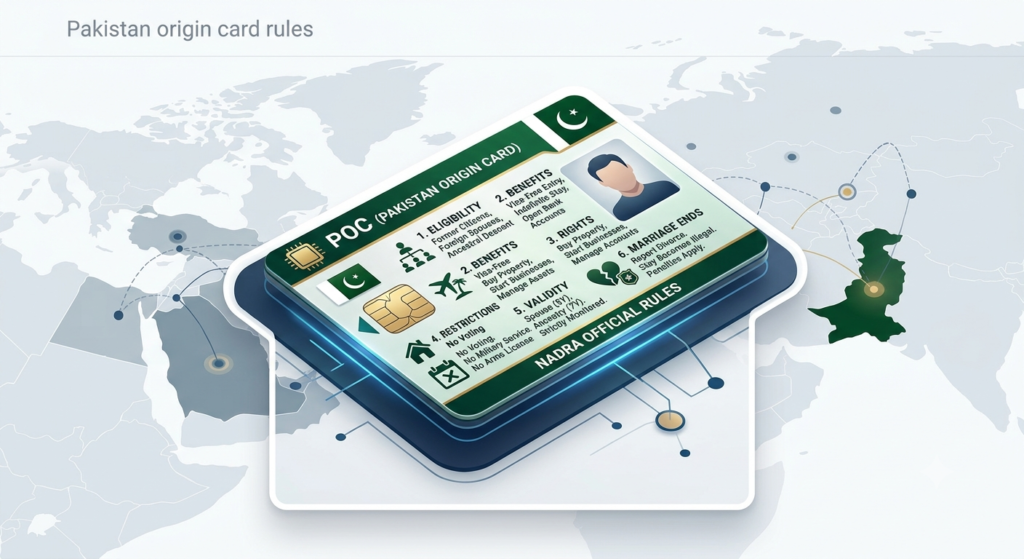
According to the official POC card eligibility criteria, three main groups of people can apply for this document. First, former Pakistani citizens who gave up their nationality for foreign passports qualify easily. Second, children or grandchildren of foreign nationals with proven Pakistani ancestry meet the POC card eligibility criteria. Third, foreign spouses who marry Pakistani citizens can obtain this card to stay together in the country. Therefore, the system accommodates diverse family setups to keep overseas communities connected to their homeland.
Key Benefits and Rights Under NADRA POC Guidelines
Holding this document unlocks numerous structural advantages for foreign nationals of Pakistani descent. Under the standard NADRA POC guidelines, cardholders enjoy visa-free entry into the country. This means you can travel to Pakistan at any time without paying for expensive visas or visiting embassies. Furthermore, the card allows you to reside in Pakistan for an indefinite period without any time limits.
In addition to easy travel, the NADRA POC guidelines grant significant economic freedom. For instance, cardholders can buy, sell, and own immovable property like houses and land anywhere in Pakistan. You can also open bank accounts easily, establish registered corporate businesses, and hire local employees. Because of these open economic rules, expatriates can manage their ancestral assets and investments without facing legal hurdles.
Important Restrictions and Legal Limitations
Although the card offers immense freedom, certain restrictions still apply to all cardholders. You must remember that this card does not equal full citizenship. For example, Pakistani expatriate card conditions strictly prohibit holders from voting in local or national elections. Furthermore, you cannot take part in any phase of the political or electoral process.
Additionally, security regulations restrict your employment options within the state. Specifically, the Pakistani expatriate card conditions bar cardholders from working in defense forces or law enforcement agencies. You can never serve in any uniformed institution of Pakistan. Finally, current laws strictly forbid cardholders from obtaining or carrying an official weapon or arms license.
Card Validity and Strict Marriage Dissolution Rules
The expiration timeline of this document depends entirely on how you apply for it. If you obtain the card through your ancestral bloodline, the card remains valid for seven years. However, the system applies a shorter timeline if you apply through a marriage link. In that specific scenario, a spouse receives a card that expires after five years.
Furthermore, you must exercise extreme caution if a marriage ends in divorce before the five-year expiration date. The law requires immediate reporting of the divorce to the authorities. Once the system registers the divorce, the card loses its legal value immediately. If a foreign national continues to reside in Pakistan after the marriage breaks down, they commit a serious offense. Consequently, the government can impose heavy financial penalties and legal punishments for illegal stays.
The Resuming Pakistani Citizenship Process
Sometimes, expatriates decide to surrender their foreign status and reclaim their original nationality. However, you cannot simply exchange your card at a local counter. You must follow the formal resuming Pakistani citizenship process step by step to avoid legal issues.
First, you must visit the Directorate General of Immigration and Passports rather than going straight to a database office. You will submit a formal application and undergo a legal evaluation there. After verifying your background, the department will issue an official Resumption of Nationality certificate. Finally, you will take this certificate to a registration office to cancel your old card and successfully obtain a new national identity card.
Handling Family Trees and Complex NADRA Issues
Many applicants face unexpected delays because of mistakes in their family records. For example, if an online renewal gets stuck on a verification hold, a data mismatch usually exists. In this case, you should email the official support desk with your tracking details to pinpoint the exact error. Similarly, if an authority blocks a relative’s card due to verification doubts, the system puts your application on hold as well. You must resolve these family tree issues by presenting independent documentation to a zonal board.
Additionally, the state has changed the rules for changing your birth details. The central database office no longer handles age corrections directly. Instead, you must visit your local Union Council first to rectify your birth record. Once the Union Council issues a revised birth certificate based on your genuine proofs, the database office will update your identity card safely.
Professional Legal Assistance for NADRA Matters
Navigating immigration rules, family tree blockages, and citizenship laws requires deep expertise. If you face complex identity card problems, expert legal guidance can save you from unnecessary delays and penalties.
For professional assistance with law services and related legal matters, contact: call any time
Muhammad Amin, Advocate 📞 Phone: 0313-9708019
📧 Email: muhammadaminadvo111@gmail.com 📍 Office: Office No. 14, Zeb Plaza, University Road, Tahkal Payan, Peshawar