
Table of Contents
- Introduction to Contractual Employment Laws
- The Story of the Bacha Khan University Case
- Explaining Fixed-term Job Rights in Pakistan
- Why the Supreme Court Rejected the High Court Order
- The Truth About Contract worker legal status
- Limits of the High Court in Job Permanency Laws
- Useful Lessons for Bosses and Workers
- Get Professional Legal Help
Introduction to Contractual Employment Laws
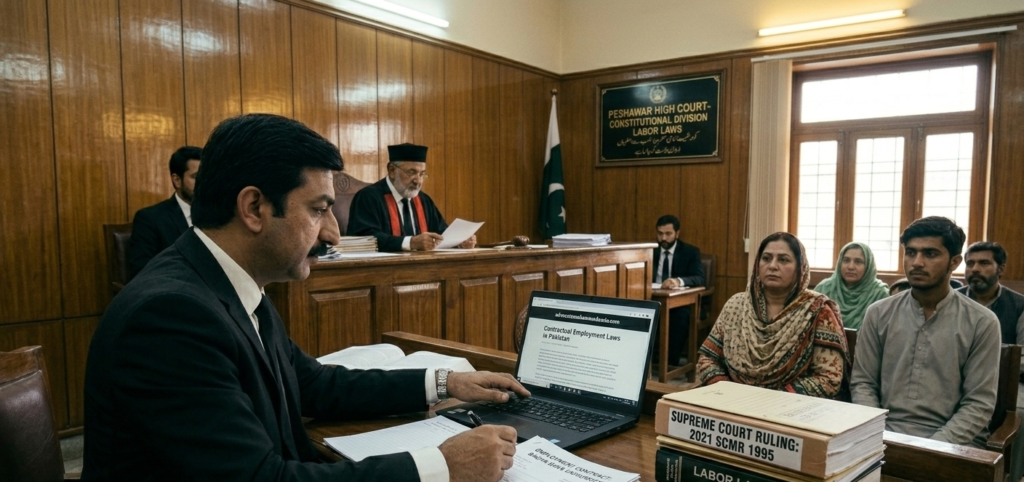
Contractual employment laws in Peshawar often confuse many hard-working people. Most workers believe that they deserve a permanent seat after serving for many years on a contract. However, the legal system in Pakistan follows very specific rules for these types of jobs. This article explains a famous Supreme Court decision that clears up the confusion for everyone. You should read this guide to understand your position whether you are a boss or an employee.
The Story of the Bacha Khan University Case
The case of Bacha Khan University Charsadda perfectly illustrates how temporary staff regulations work today. The university hired many people on short-term contracts back in 2012. Although the university renewed these contracts several times, it never promised them a permanent future. Eventually, the workers asked the Peshawar High Court to turn their temporary roles into permanent ones. The High Court initially supported the workers, but the university then challenged this in the Supreme Court of Pakistan.
Explaining Fixed-term Job Rights in Pakistan
The Supreme Court studied the concept of fixed-term job rights very closely during this appeal. The judges needed to decide if a long-running contract automatically gives someone the right to stay forever. Many employees feel that their loyalty over many years creates a legal bond. However, the law usually looks at the specific paper that both sides signed at the start. Understanding this helps everyone set the right expectations from the very first day of work.
Why the Supreme Court Rejected the High Court Order
The Supreme Court finally decided to cancel the previous order and supported the university. The judges explained that contractual employment laws do not allow for automatic permanent status. Just because a manager extends your contract does not mean they must hire you permanently. The court views a contract as a deal with a clear end date. Therefore, the employer keeps the final choice to either renew the agreement or end the relationship.
The Truth About Contract Worker Legal Status
This ruling highlights the actual contract worker legal status within the Pakistani justice system. The law treats a contract as a private deal between a worker and a company. Unless a specific government policy protects you, the terms of your contract control your future. Consequently, you cannot use a court to force a permanent job out of a temporary agreement. This reality means that every worker must check their own department rules instead of relying only on a judge.
Limits of the High Court in Job Permanency Laws
The Supreme Court also talked about the limits of the High Court when it handles job permanency laws. Under Article 199, the High Court can only check if a government office broke an existing law. It cannot create new rights or force a boss to offer a permanent salary without a legal reason. The Supreme Court warned that judges must not interfere with the internal hiring choices of schools or offices. This ensures that every organization can manage its own money and staff correctly.
Useful Lessons for Bosses and Workers
Everyone can learn something from these employment regularization rules. If you are a worker, you must read your agreement carefully and look for any special regularization policies in your office. If you are an employer, this case confirms that you have the power to manage your team as you see fit. Always put your deals in writing and follow the official rules for renewals. Taking these simple steps prevents big legal headaches in the future.
Get Professional Legal Help
If you have a problem with your job contract or need advice on labor laws, you should talk to a professional advocate. We understand the latest Supreme Court rulings and can guide you through these difficult times. Our office provides clear and honest help for both workers and companies in Peshawar.
Muhammad Amin, Advocate Phone: 0313-9708019 Email: muhammadaminadvo111@gmail.com Office: Office No. 14, Zeb Plaza, University Road, Tahkal Payan, Peshawar