Table of Contents
- Why Age Matters in Criminal Justice
- The Law Governing Juvenile Status
- How Courts Analyze Evidence for Age
- The Role of Medical Science and Ossification Tests
- Lessons from the Peshawar High Court
- Protecting Rights Through Timely Claims
- Getting Expert Legal Help
Why Age Matters in Criminal Justice
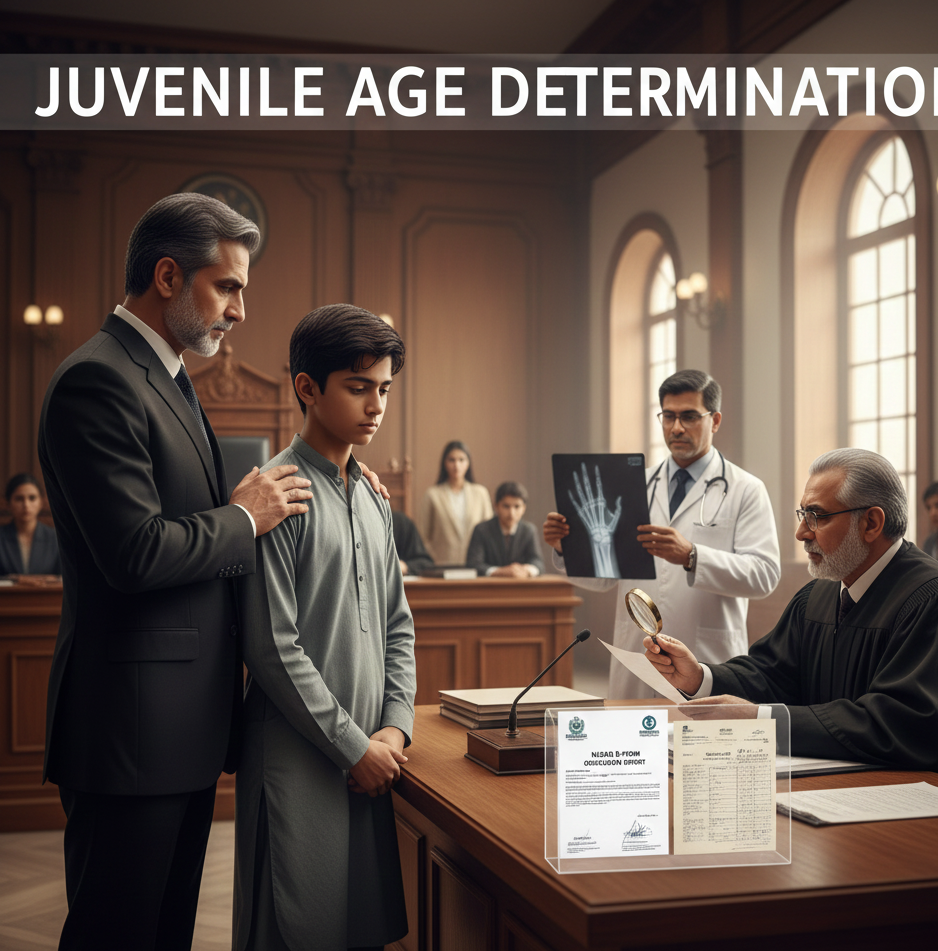
Juvenile age determination plays a vital role when courts handle serious criminal charges in Pakistan. The exact age of an accused person changes how the entire legal system treats them. If a court confirms a person is a minor, that individual receives special protections under the law. These protections include separate detention facilities and shorter sentences. Therefore, accurate age assessment ensures that children do not face the same harsh penalties as adults.
The Law Governing Juvenile Status
The Juvenile Justice System Act provides clear rules for verifying the age of an accused person. Section 7 of this law explains exactly how a judge must conduct an inquiry. When a person claims they are a minor, the court must investigate the matter immediately. The legal system places the burden of proof on the person who claims to be a juvenile. This means the accused must provide strong evidence like birth certificates or school records to prove their minority status.
How Courts Analyze Evidence for Age
Courts look at several types of documents during the juvenile age determination process. Judges usually follow a specific hierarchy when evidence conflicts. Government records from NADRA typically carry the most weight because they are official and verified. School certificates can also help, but judges often find them less reliable if the dates look inconsistent. In many cases, the court prefers family tree documentation and computerized identity records over hand-written school registers.
The Role of Medical Science and Ossification Tests
When documents are missing or suspicious, the court relies on medical science. A specialized medical board performs an ossification test to estimate the age of the accused. This test involves taking X-rays of specific bones and joints to see how much they have developed. While this test provides a range rather than an exact day, it helps judges decide if a person is likely over 18. Medical evidence often provides the final word in difficult juvenile age determination cases.
Lessons from the Peshawar High Court
A famous case involving an accused man named Muhammad Kamal shows how high courts handle these issues. Kamal faced murder charges, but his age remained unclear during the first trial. The Peshawar High Court later ordered a fresh inquiry because the original records contained errors. The court discovered that while school records were confusing, NADRA records and medical tests proved he was an adult. This case teaches us that courts will look past simple paperwork to find the truth.
Protecting Rights Through Timely Claims
The timing of an age claim significantly affects its success. Judges usually trust claims that an accused person makes right after their arrest. If a person waits until the end of a trial to say they are a minor, the court may view the claim with suspicion. Consistency across all official documents also prevents future legal problems. Anyone seeking juvenile status should present their evidence as early as possible to ensure they receive the full protection of the law.
Getting Expert Legal Help
Navigating the juvenile justice system requires a deep understanding of evidence and court procedures. A skilled lawyer knows how to gather the right documents and request medical boards when necessary. Proper legal representation can mean the difference between an adult prison and a juvenile rehabilitation center. If you or a loved one faces criminal charges while being under the age of 18, you must act quickly to establish your true age in court.
For professional assistance with criminal law services and related legal matters, contact:
Muhammad Amin, Advocate 📞 Phone: 0313-9708019 | 0335-1990495