
Table of Contents
- Introduction to Islamic Divorce
- Husband Initiated Divorce Methods
- Wife Initiated Divorce Options
- Mutual Consent and Joint Decisions
- Legal Grounds for Judicial Divorce
- Expert Legal Assistance for Divorce Cases
Introduction to Islamic Divorce
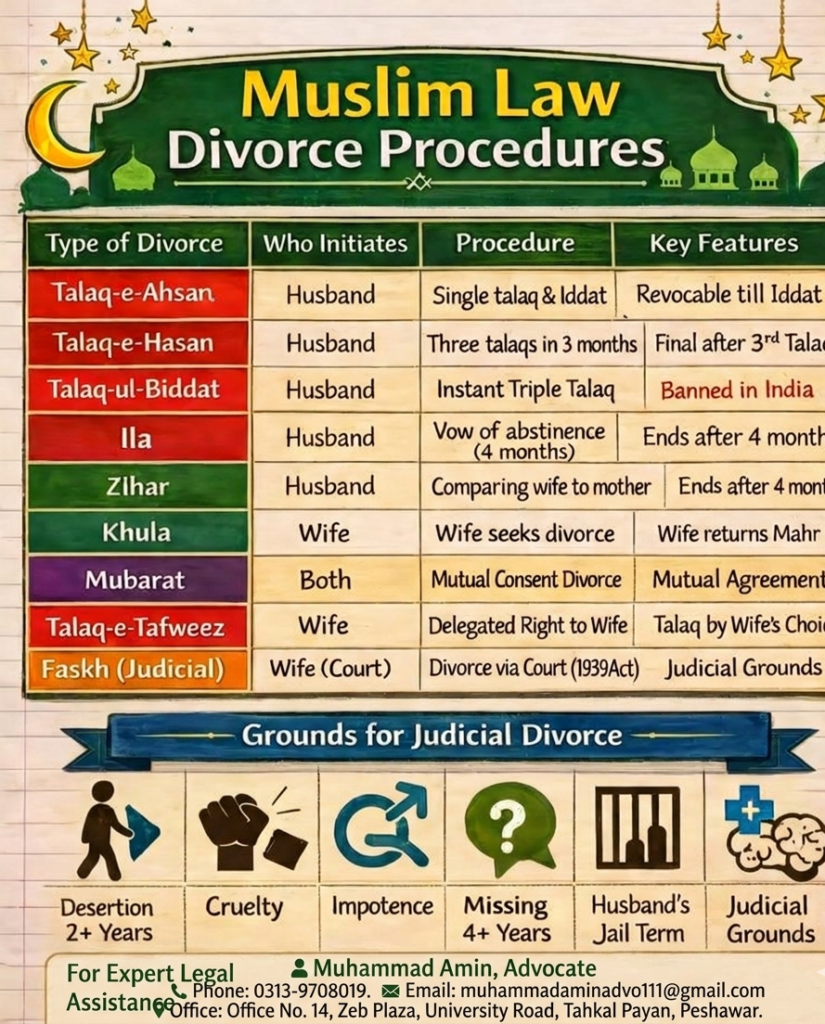
Muslim divorce procedures provide specific ways for a husband and wife to end their marriage. Islamic law offers several paths for this process. People often find these rules confusing, but we can explain them simply. This article describes how these laws work in everyday life. Understanding these rules helps families make better decisions during hard times.
Husband Initiated Divorce Methods
A husband can start the Muslim divorce procedures through different types of Talaq. Talaq-e-Ahsan allows a single statement followed by a waiting period. The husband can change his mind during this time. Talaq-e-Hasan requires three statements over three months. This version becomes final only after the third time. Some people mention Talaq-ul-Biddat or instant triple Talaq. However, many countries like India now ban this specific practice. Other rare forms include Ila and Zihar. In these cases, the husband makes a vow or uses specific words to distance himself from his wife. These methods usually end after four months.
Wife Initiated Divorce Options
The wife also has powerful rights within Muslim divorce procedures. She can ask for Khula if she no longer wishes to stay in the marriage. In this situation, the wife usually returns her dower or Mahr to the husband. Another option is Talaq-e-Tafweez. Here, the husband delegates his right of divorce to the wife. This allows the wife to choose divorce herself if the couple agreed to this in their marriage contract. These options ensure that women have a clear legal path to seek freedom when necessary.
Mutual Consent and Joint Decisions
Sometimes both partners agree to separate peacefully. This part of Muslim divorce procedures is called Mubarat. In a Mubarat divorce, the husband and wife reach a mutual agreement. They decide to end the marriage together without blaming each other. This method often results in a smoother transition for children and family members. It shows that Islamic law values harmony and cooperation even during a separation.
Legal Grounds for Judicial Divorce
A wife can also go to court for a Faskh or judicial divorce. The law lists several reasons for this action. A wife can sue if the husband disappears for more than four years. She can also seek a divorce if the husband fails to provide money for two years. Other grounds include the husband going to jail for seven years or more. Cruelty and physical harm also give the wife a right to end the marriage through a judge. These rules protect women from neglect and abuse within the legal system.
Expert Legal Assistance for Divorce Cases
Navigating Muslim divorce procedures requires professional help and clear guidance. Legal experts can explain your rights and help you file the correct paperwork. If you need help with these matters, you can find support easily. For professional assistance with law services and related legal matters, contact Muhammad Amin, Advocate.
You can call him any time at 0313-9708019. You can also send an email to muhammadaminadvo111@gmail.com. His office is at Office No. 14, Zeb Plaza, University Road, Tahkal Payan, Peshawar.