Table of Contents
- Introduction to Marital Rights
- The Legal Genesis of Spousal Support Laws
- Challenging the Maintenance-Obedience Concept
- Rukhsati and Financial Support After Marriage
- The Supreme Court Protection of Wife Maintenance Rights
- A Rights-Oriented Approach to Marital Financial Obligations
- Conclusion on Legal Right to Maintenance
- Professional Legal Contact Information
Introduction to Marital Rights
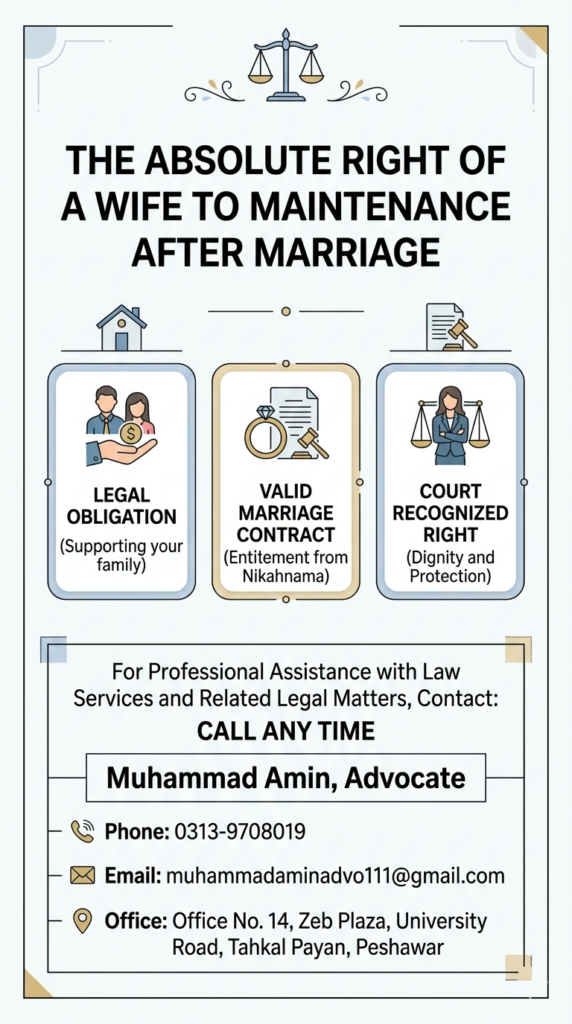
Marriage serves as a sacred bond and a civil contract that creates immediate legal duties for both partners. Many people mistakenly believe that a wife only earns her right to financial support after she moves into her husband’s house. However, recent judicial rulings clarify that the marital bond creates an immediate obligation for the husband to provide for his wife. This article explores how the law protects women from economic vulnerability the moment they sign the Nikahnama.
The Legal Genesis of Spousal Support Laws
A valid marriage begins the moment both parties exchange an offer and acceptance with free consent. This legal act serves as the foundation for spousal support laws in Pakistan. The law does not require the couple to live together before the husband starts his duty of providing financial help. Since the Nikahnama acts as a binding civil contract, the husband must fulfill his promises immediately. Therefore, the wife gains her status as a beneficiary of maintenance as soon as the registrar completes the marriage documents.
Challenging the Maintenance-Obedience Concept
Historically, some interpretations suggested that a wife must show total obedience to receive food and shelter. This outdated idea, often called the maintenance-obedience complex, wrongly treats marriage like a business transaction. Modern courts now reject this view because it violates the dignity of women. The Quran describes marriage as a relationship of love and mercy rather than a master-servant dynamic. Consequently, the legal right to maintenance stands as an independent right that does not depend on physical submission or patriarchal control.
Rukhsati and Financial Support After Marriage
The social custom of Rukhsati often delays the time when a couple starts living together. However, Rukhsati holds no independent legal status under Islamic or statutory law regarding financial support after marriage. If a husband fails to arrange a home or neglects to take his wife to his house, he cannot use his own delay as an excuse to stop payments. The law places the burden of proof on the husband to show that a wife refused to live with him without a valid reason. If the husband remains inactive, the wife’s right to receive money continues without interruption.
The Supreme Court Protection of Wife Maintenance Rights
The Supreme Court of Pakistan recently issued a landmark judgment to safeguard wife maintenance rights. The court set aside previous decisions that denied support to women whose marriages were not consummated. The judges ruled that the lack of physical intimacy does not cancel the husband’s duty if he was the one who failed to facilitate the living arrangements. This ruling ensures that maintenance acts as a shield against poverty. It prevents husbands from using financial neglect as a tool of coercion during the subsistence of a marriage.
A Rights-Oriented Approach to Marital Financial Obligations
Justice and equality demand that we interpret laws in a way that empowers vulnerable family members. Courts now look at marital financial obligations through the lens of constitutional rights and human dignity. This approach ensures that women receive their dues even during the pendency of litigation or during the iddat period after a divorce. Because the law views maintenance as an absolute right, statutes like the Muslim Family Laws Ordinance provide quick procedures for women to recover their arrears through the Family Courts.
Conclusion on Legal Right to Maintenance
A valid marriage is more than a simple agreement; it is a commitment to care and mutual respect. The legal right to maintenance remains a fundamental pillar of this commitment from day one. Husbands must understand that their financial duties begin at the wedding ceremony, not at the bedroom door. By upholding these rights, the legal system ensures that marriage remains a source of security and justice for every woman in society.
For professional assistance with law services and related legal matters, contact: Call any time
Muhammad Amin, Advocate 📞 Phone: 0313-9708019
📧 Email: muhammadaminadvo111@gmail.com
📍 Office: Office No. 14, Zeb Plaza, University Road, Tahkal Payan, Peshawar