Table of Contents
- A Landmark Victory for Legal Succession Rights
- The Background of the Long Property Dispute Resolution
- How Revenue Record Correction Changed the Case
- The Application of Muslim Inheritance Law Principles
- The Impact of the Court Verdict on Lawful Heirs’ Entitlement
- Seeking Expert Legal Guidance
A Landmark Victory for Legal Succession Rights
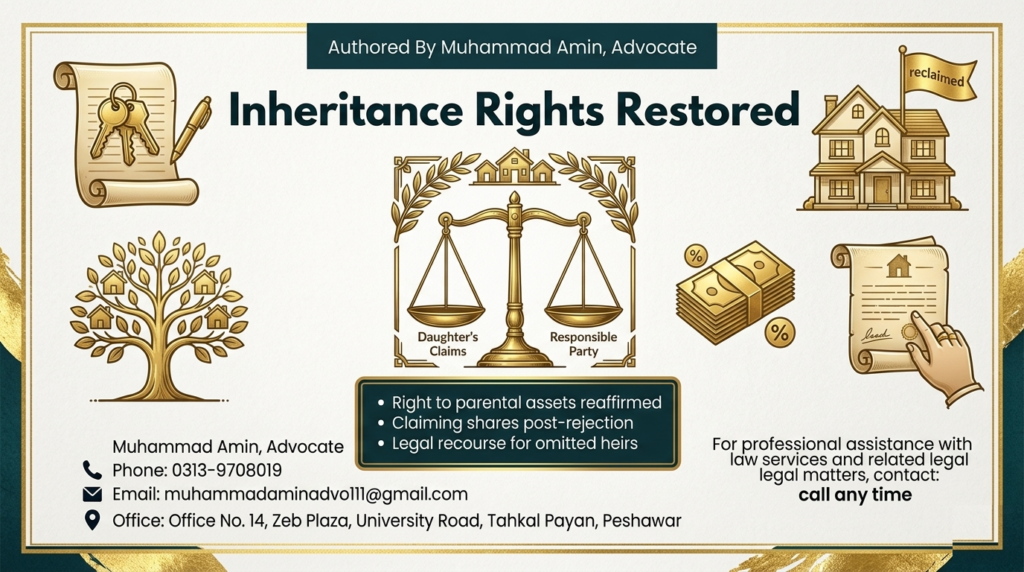
The Federal Constitutional Court recently delivered a historic judgment that finally closes a massive gap in justice. Chief Justice Ameenuddin Khan led the division bench that restored the legal succession rights of Sardar Begum’s family. This decision brings an end to a painful struggle that lasted nearly seven decades. The court confirmed that administrative errors cannot strip a family of their rightful property. This ruling serves as a beacon of hope for many other families who face similar administrative hurdles in the legal system.
The Background of the Long Property Dispute Resolution
This specific property dispute resolution began because of a mistake that happened back in 1958. Sardar Begum passed away that year, which was ten years before her father, Chaudhry Abdullah Khan, died. When authorities processed the inheritance papers in 1968, they completely left her name out of the official documents. Consequently, her children lost their entire share of the family estate for sixty-eight years. The legal team argued that this omission ignored the reality of the family lineage and created a cycle of injustice that affected multiple generations.
How Revenue Record Correction Changed the Case
The case shifted dramatically when the court focused on the necessary revenue record correction. Senior counsel Hafiz Ahsaan Ahmad Khokhar explained that the initial records contained a fundamental flaw rather than a simple clerical error. He pointed out that the consolidation of land in Mouza Dhaunkal relied on a faulty family tree. Because the officials used an incomplete pedigree table, the entire land distribution process became legally void. The court eventually accepted that no administrative process can stand if it ignores the existence of a lawful daughter and her descendants.
The Application of Muslim Inheritance Law Principles
The court based its decision on the firm foundations of Muslim inheritance law. Under these rules, inheritance rights trigger the very moment a person passes away. The judges noted that a daughter remains a primary heir even if she dies before the formal distribution of the estate occurs. Furthermore, a key witness provided a statement on oath that confirmed Sardar Begum’s parentage. This testimony removed any remaining doubts about the family tree. Therefore, the court ruled that the law must protect the branch of the family that the previous officials had wrongly excluded.
The Impact of the Court Verdict on Lawful Heirs’ Entitlement
This ruling establishes a powerful precedent regarding lawful heirs’ entitlement in Pakistan. The bench observed that the state must reflect the status of every child in inheritance mutations to ensure fair distribution. Even though the consolidation process finished decades ago, the court prioritized the truth over old paperwork. This decision proves that the law values the actual bloodline more than a defective piece of paper. Now, the descendants of Sardar Begum will finally receive the land and recognition that their grandfather intended for them to have.
Seeking Expert Legal Guidance
Navigating complex land laws and inheritance matters requires a deep understanding of procedural rules. If you face challenges with property records or inheritance disputes, professional advice can make a significant difference. You can find dedicated support for these issues by contacting an experienced legal professional.
For professional assistance with law services and related legal matters, contact:
Muhammad Amin, Advocate 📞 Phone: 0313-9708019 📧 Email: muhammadaminadvo111@gmail.com 📍 Office: Office No. 14, Zeb Plaza, University Road, Tahkal Payan, Peshawar