The Concept of Disowning a Child in Pakistani Society
Many parents in Pakistan face deep frustration due to the bad conduct or financial misdeeds of their children. Consequently, these parents often declare publicly that they cut all ties with their problematic son or daughter. Society commonly calls this public declaration an Aaq Nama or a disowning document. People generally believe that this document completely destroys the child’s right to inherit any family property. However, a massive gap exists between social beliefs and the actual statutory rules of the country.
The True Legal Status of Aaq Nama in Pakistan
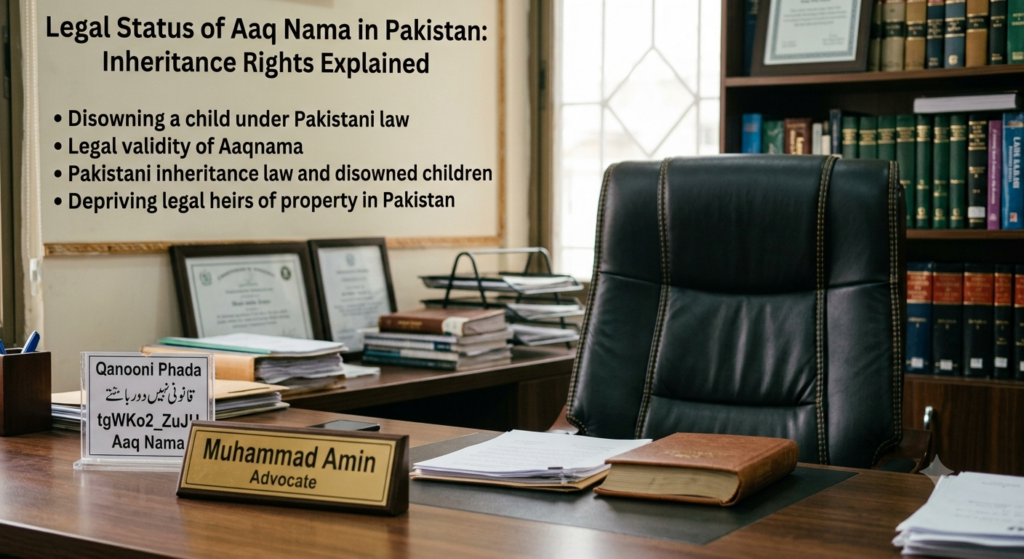
When we look at the strict legal landscape, the legal status of Aaq Nama in Pakistan carries absolutely no weight in a court of law. No person can legally sever a biological relationship through a written declaration or an announcement. Therefore, the state does not change the father’s name on the child’s Computerized National Identity Card based on such a document. The law views the relationship between a parent and a child as a permanent biological bond that no individual can dissolve through personal paperwork.
How Pakistani Inheritance Law Protects Disowned Children
The Islamic law of inheritance, which forms the basis of Pakistani inheritance law and disowned children, governs property distribution after death. This legal system clearly dictates that inheritance only opens at the exact moment a property owner dies. At that specific moment, the law automatically creates the rights of the surviving legal heirs. Since the owner does not own the property after their death, they cannot choose to block a rightful heir. Thus, the legal validity of Aaqnama completely fails when a court distributes the deceased person’s estate.
Why Parents Publish Newspaper Notices for Disowning
If an Aaq Nama does not stop inheritance, one might wonder why parents still publish these notices in newspapers. Parents utilize this method strictly as a tool for social and moral boundary-setting. They want to inform the general public and financial institutions that they do not bear responsibility for the child’s debts or criminal actions. This public notice protects the parents from legal liabilities that the child might create during their lifetime, but it still fails to alter the rules of future property distribution.
Final Verdict on Property Distribution and Legal Heirs
In conclusion, a disowned child remains a fully valid legal heir under the law of the land. The siblings or other relatives cannot use a past عاق نامہ to stop a brother or sister from claiming their legal share. When a court evaluates the estate, it will distribute the assets among all alive heirs according to their fixed legal percentages. Therefore, anyone attempting depriving legal heirs of property in Pakistan through a disowning deed will fail in front of a judge.
Professional Legal Assistance for Inheritance Matters
Property distribution and family disputes require clear, expert guidance to avoid long court battles. If you are facing issues regarding a disowning deed or need to resolve a property dispute, you should seek reliable legal support right away.
For professional assistance with law services and related legal matters, contact: call any time
Muhammad Amin, Advocate
📞 Phone: 0313-9708019
📧 Email: muhammadaminadvo111@gmail.com
📍 Office: Office No. 14, Zeb Plaza, University Road, Tahkal Payan, Peshawar