
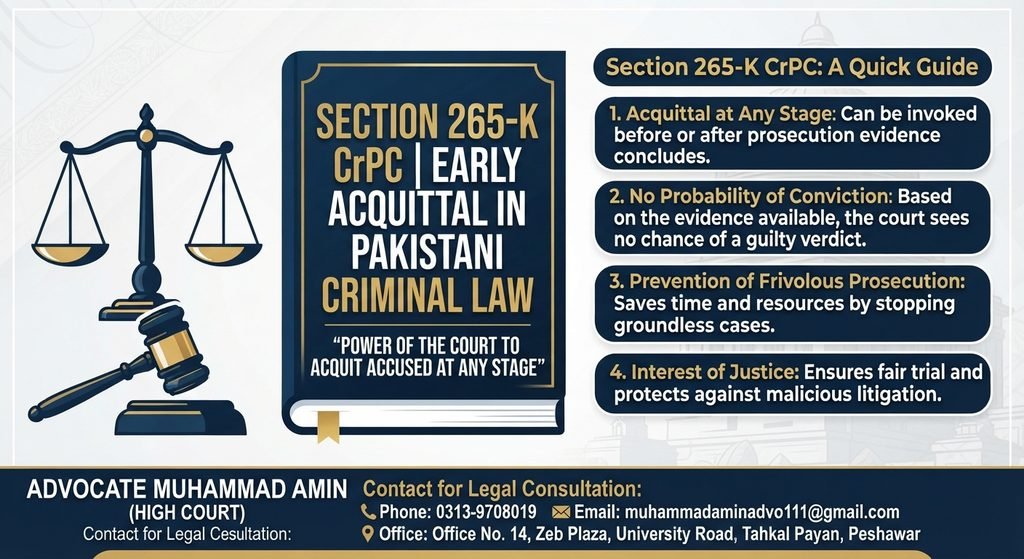
Introduction to Section 265-K CrPC
Facing a criminal charge can create serious stress for an accused person and their family. Many individuals fear spending months or even years attending court hearings, particularly when they believe the case rests on weak evidence or false allegations.
However, Pakistani criminal procedure provides an important legal remedy under Section 265-K of the Code of Criminal Procedure, 1898. This provision empowers the trial court to acquit an accused person before the conclusion of the trial when the statutory requirements are satisfied. It can prevent unnecessary continuation of proceedings where the court finds no probability of conviction.
What Is Section 265-K of the Criminal Procedure Code?
Section 265-K of the Code of Criminal Procedure, 1898, deals with the power of the court to acquit an accused person at any stage of a trial. The provision applies where, after hearing the prosecutor and the accused and examining the available record, the court considers that there is no probability of the accused being convicted of any offence.
In such circumstances, the court may record its reasons and acquit the accused person. The purpose of this provision is to prevent the unnecessary continuation of a criminal trial where the available material does not justify proceeding further.
Importantly, the court does not grant acquittal merely because the accused denies the allegations. Instead, it evaluates the prosecution material, relevant circumstances, and applicable legal principles before exercising this power.
How Section 265-K Protects You Against Baseless Criminal Cases
Sometimes, a criminal case proceeds despite serious weaknesses in the prosecution’s evidence. The accused may face repeated court appearances, financial pressure, and damage to personal or professional reputation.
Section 265-K provides a legal mechanism to address such situations. The defence may draw the court’s attention to material contradictions, missing evidence, legal defects, or circumstances showing that the prosecution has no reasonable probability of securing a conviction.
The court then examines the available record and hears the parties. If the statutory test is satisfied, it may acquit the accused without requiring the trial to continue through every remaining stage.
When Can the Court Acquit an Accused Person Under Section 265-K?
The court may consider an application under Section 265-K at any stage of the trial. However, the accused must establish grounds that justify the exercise of this exceptional power.
Relevant circumstances may include serious weaknesses in the prosecution evidence, material contradictions in the available record, absence of evidence connecting the accused with the alleged offence, or legal circumstances showing that conviction is not probable.
The court must assess the facts and evidence of each individual case. A mere delay in proceedings, denial of allegations, or a general claim of innocence does not automatically justify acquittal under this provision.
How to File an Application Under Section 265-K CrPC
An application under Section 265-K should clearly identify the legal and factual grounds supporting early acquittal. The defence counsel must carefully examine the FIR, statements of prosecution witnesses, investigation record, documentary evidence, and other relevant material.
The application should explain why the available prosecution material does not establish a probability of conviction. It should also refer to relevant statutory provisions and judicial precedents that support the defence position.
After filing the application, the court considers the submissions of the prosecutor and the accused. It may examine the available record before deciding whether to acquit the accused or allow the trial to continue.
Why You Need Experienced Legal Assistance
Seeking acquittal under Section 265-K requires careful legal analysis and effective courtroom advocacy. A poorly prepared application may fail to address the statutory requirements or the weaknesses in the prosecution record.
Advocate Muhammad Amin, Advocate High Court, provides legal assistance in criminal defence, bail matters, acquittal applications, and other criminal proceedings in Peshawar. Each case requires an independent assessment of its facts, evidence, applicable law, and available remedies.
Our approach focuses on examining the complete case record, identifying relevant legal issues, preparing appropriate applications, and presenting the defence position before the competent court.
Take Legal Action to Protect Your Rights
If you are facing a criminal case that relies on weak evidence or questionable allegations, you should obtain professional legal advice without unnecessary delay. An assessment of your case may help determine whether an application under Section 265-K CrPC is legally maintainable.
For criminal defence, bail applications, acquittal proceedings, and related legal assistance in Peshawar, contact our office to discuss your matter.
Professional Legal Assistance
For professional assistance with criminal defence, Section 265-K applications, acquittal proceedings, and related legal matters, contact:
Muhammad Amin
Advocate High Court
Phone:
0313-9708019
Email:
muhammadaminadvo111@gmail.com
Office Address:
Office No. 14, Second Floor, Zaib Plaza, University Road, Tahkal Payan, Peshawar, Pakistan.