
Introduction to Anti Terrorism Court Jurisdiction Kidnapping Ransom
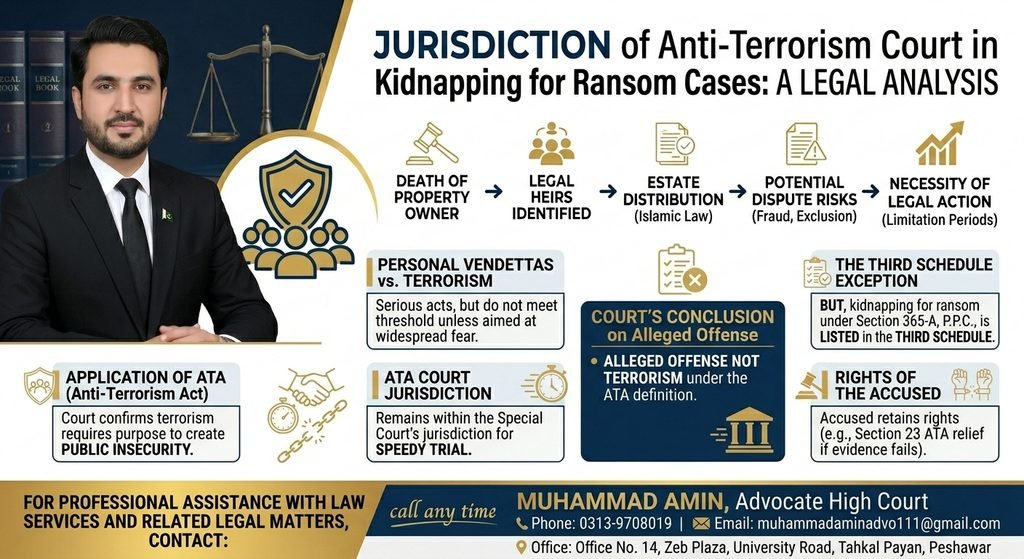
Many accused persons face serious trial proceedings under special security laws in Pakistan without understanding how forum jurisdiction works. Understanding Anti Terrorism Court jurisdiction kidnapping ransom cases helps defense teams choose the correct forum for trial. Accused individuals often seek a transfer of trial to ordinary court when an alleged crime lacks the element of public terrorism. However, special trial courts maintain jurisdiction over specific offenses that the legislature includes in statutory schedules. Navigating complex procedural rules under the Anti-Terrorism Act requires immediate intervention from an experienced criminal defense lawyer.
Legal Background and Details of the Kidnapping Case
This landmark procedural dispute arose when an applicant challenged the jurisdiction of the Anti-Terrorism Court during trial. The complainant originally reported the abduction of his son for a financial ransom demand. Police authorities initially questioned the applicant as a witness, but later recorded a confession that led to the recovery of the victim’s body. Consequently, investigating authorities charged the accused under Section 365A PPC and Section 7 of the Anti-Terrorism Act. The accused subsequently filed an application requesting a transfer of trial to ordinary court on jurisdictional grounds.
Strategic Defense Arguments in Kidnapping Trials
The defense team argued that the prosecution misapplied Section 365A PPC because the case lacked credible evidence of a ransom demand. Furthermore, the defense asserted that private personal grudges do not fall under special anti-terrorism legislation. They relied upon landmark Supreme Court precedents like the Ghulam Hussain case to demonstrate that personal vendettas remain outside the definition of terrorism. A skilled Section 365A PPC defense lawyer builds these precise legal arguments to challenge improper charges before the trial judge.
Arguments Raised by the Prosecution
The prosecution strongly opposed the transfer application and requested the court to retain the case. Prosecutors argued that the extrajudicial confession explicitly established a planned kidnapping for ransom under penal provisions. They insisted that the severe nature of the crime fulfilled the criteria under Section 365A PPC and Section 7(e) of the Anti-Terrorism Act. Therefore, the prosecution maintained that the special trial tribunal held exclusive authority to conclude the proceedings.
Court Analysis on ATA Act Application and Terrorism Definition
The court carefully analyzed the statutory definition of terrorism under the Anti-Terrorism Act. The judge confirmed that genuine terrorism requires a distinct design to create widespread public insecurity or spread terror among citizens. While personal vendettas constitute severe criminal acts, they do not automatically meet the legal threshold of terrorism. Therefore, the court observed that ordinary criminal acts arising from private disputes do not form terrorism per se under the primary provisions of the law.
The Role of the Third Schedule of the Anti Terrorism Act
Despite finding no element of public terror, the court examined the Third Schedule of the Anti-Terrorism Act. The legislature explicitly includes kidnapping for ransom under Section 365A PPC in the Third Schedule to ensure speedy trial proceedings. Consequently, the Third Schedule grants ATA court jurisdiction kidnapping case matters even when the offense lacks a wider terrorist design. This legal mechanism guarantees fast-track prosecution while keeping the trial strictly within the specialized court system.
Final Decision of the Court and Next Steps
The court ultimately dismissed the application and refused to transfer the case to a regular sessions judge. The court ruled that the trial must continue in the Anti-Terrorism Court due to statutory schedule coverage. However, the court highlighted that the accused retains the right to seek formal relief under Section 23 of the ATA if prosecution evidence fails to substantiate kidnapping for ransom during cross-examination. Proper cross-examination during trial remains crucial to unlocking these legal remedies.
Protecting Your Rights with an Expert Criminal Defense Lawyer
Navigating special court procedures, challenging improper charges, and cross-examining prosecution witnesses demands exceptional trial experience. Facing trial in special courts without a solid legal strategy puts your liberty and rights at extreme risk. I thoroughly review prosecution files, challenge jurisdictional errors, and deliver powerful courtroom advocacy to defend your freedom. Contact my office today to analyze your case documents and secure top-tier criminal defense representation.
For professional assistance with law services and related legal matters, contact: call any time
Muhammad Amin, Advocate High Court
📞 Phone: 0313-9708019
📧 Email: muhammadaminadvo111@gmail.com
📍 Office: Office No. 14, Zeb Plaza, University Road, Tahkal Payan, Peshawar