
Introduction to Legal Heirship and Inheritance Disputes
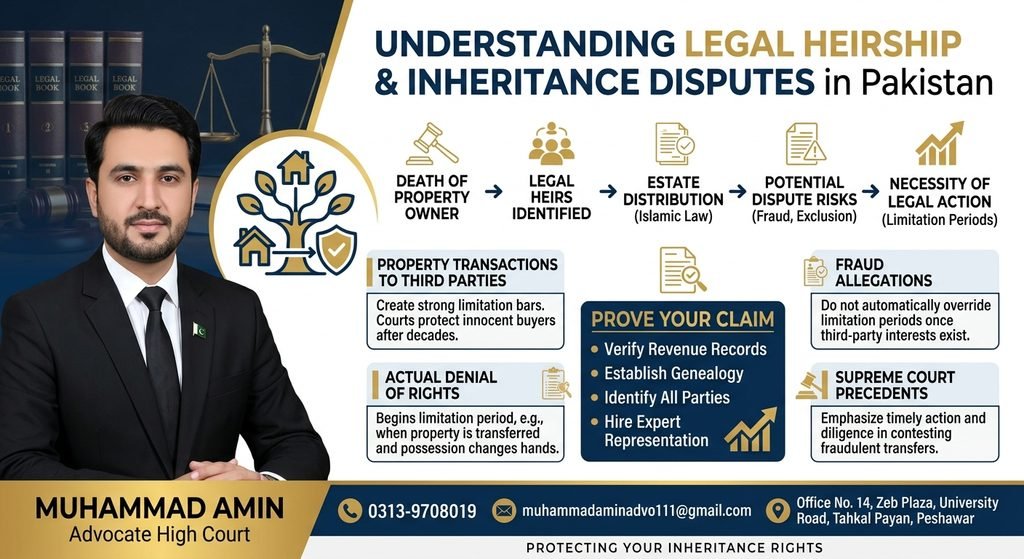
Many family members believe that they can claim their share in property at any time without facing legal deadlines. While Islamic inheritance property laws protect your rightful share, Pakistani courts strictly enforce time limitations when third-party rights enter the equation. Delays in challenging illegal sales can destroy your chances of recovering ancestral land. You must act immediately when someone deprives you of your legitimate inheritance. Understanding how courts handle legal heirship and inheritance disputes helps you take proper legal steps before time runs out.
The Facts Behind the Landmark Property Case
This legal dispute began when the descendants of Qaim Khan challenged property transfers that occurred over sixty years ago. The appellants claimed their share through Mst. Khanzadi, who had passed away three decades before they filed the lawsuit. During those long decades, multiple family members sold different portions of the property in Mouza Bostan and Mouza Chacher Tappa Talli to outside buyers. However, the legal heirs failed to include all the third-party buyers in their lawsuit, which created serious legal complications for their claim.
Claims of Fraud and Inheritance Law Arguments
The legal heirs argued that family members committed fraud by excluding Mst. Khanzadi from the family ownership record (Shajra Nasab). They insisted that fraud completely cancels all time limits in property claims. Furthermore, they asserted that Islamic law gives every legal heir an absolute right to property that never expires. They believed that delayed knowledge of the fraudulent transfer allowed them to file the case decades later to recover their ancestral share.
Defense Arguments Regarding Limitation and Third Party Interests
The buyers and current owners strongly opposed the lawsuit by raising the bar of limitation. They pointed out that the original legal heirs remained silent during their entire lifetimes and never challenged the sales. Furthermore, buyers had spent massive resources purchasing and developing the land over sixty years. The defense argued that the law protects innocent third-party buyers who purchase property in good faith, especially when original owners sleep on their legal rights for decades.
How Courts Distinguish Between Threat and Actual Denial of Rights
The court carefully analyzed the crucial legal difference between a mere threat to your rights and an actual denial of your rights. A wrong entry in revenue records acts as a threatened denial, but an actual property transfer to a third party serves as a complete denial of your ownership. The moment a party transfers the land and hands over possession, the statutory time limit starts ticking immediately. Therefore, legal heirs cannot claim constructive possession once outside buyers occupy the land under registered sale transactions.
Important Precedents from the Supreme Court of Pakistan
The Supreme Court of Pakistan reinforced this rule through key legal rulings including Noor Din v. Pervaiz Akhtar, Salamat Ali v. Muhammad Din, and Mst. Rabia Gula v. Muhammad Janan. These landmark judgments clearly state that legal heirs must show extreme diligence in contesting fraudulent property transfers. The courts explicitly refuse to overturn decades-old land transactions when original claimants failed to take action during their lifetimes. Consequently, these precedents protect long-standing property transactions and enforce strict deadlines on ancient inheritance claims.
Protecting Your Property Rights with Professional Legal Counsel
Navigating complex property litigation requires deep knowledge of civil procedure, land revenue records, and recent judicial precedents. Delaying your legal action by even a few months can cost you your entire ancestral estate. I thoroughly investigate land records, challenge fraudulent transfers, and build rock-solid property claims to defend your rightful inheritance. Contact my office today to analyze your property documents and secure expert courtroom representation before time runs out.
For professional assistance with law services and related legal matters, contact: call any time
Muhammad Amin, Advocate High Court
📞 Phone: 0313-9708019
📧 Email: muhammadaminadvo111@gmail.com
📍 Office: Office No. 14, Zeb Plaza, University Road, Tahkal Payan, Peshawar