
Table of Contents
- Introduction to the Supreme Court Ruling on Judicial Review
- Understanding the Limits of High Court Power
- When the High Court Must Remand a Case to Lower Courts
- How This Constitutional Law Precedent Affects Family Law
- The Importance of Proper Writ Jurisdiction Boundaries
- Final Thoughts on the Hierarchy of Courts in Pakistan
- Professional Legal Support for Constitutional Matters
Introduction to the Supreme Court Ruling on Judicial Review
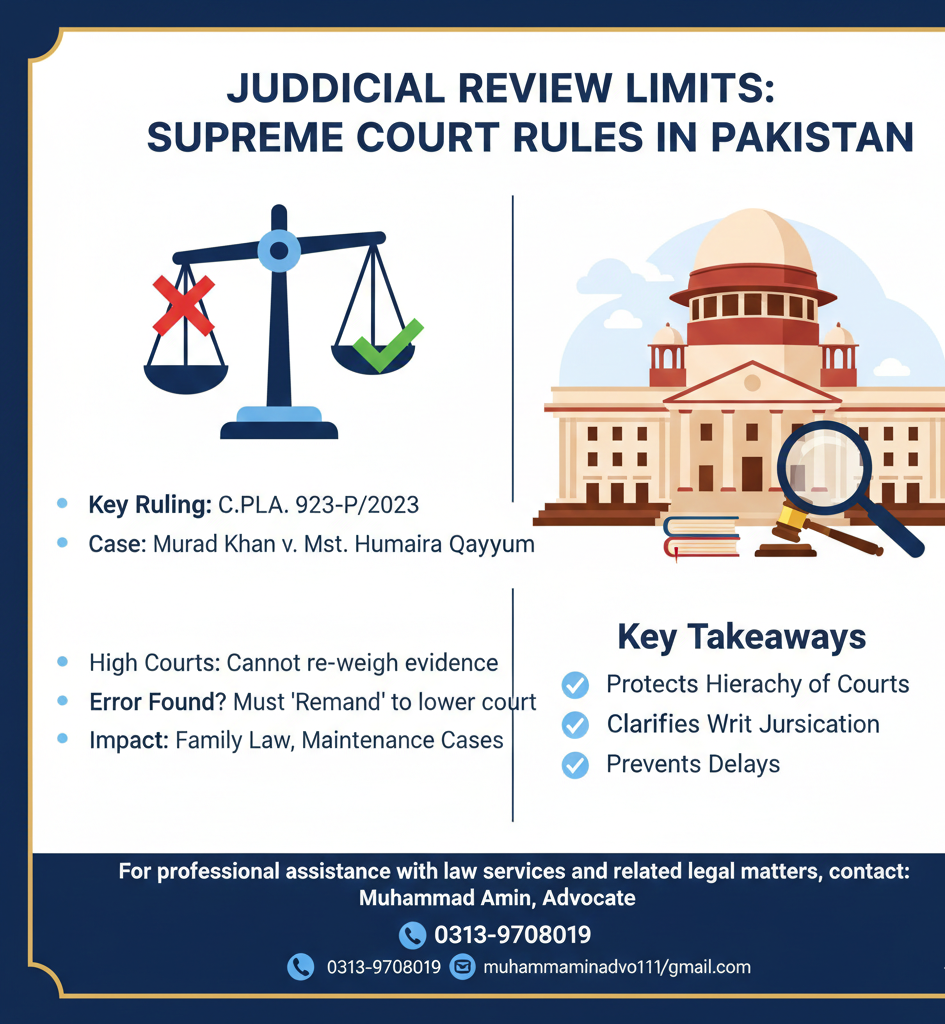
The Supreme Court of Pakistan recently delivered a major judgment regarding how superior courts handle legal challenges. This case involved a dispute titled Murad Khan v. Mst. Humaira Qayyum. The primary focus of the ruling centers on the specific judicial review limits under Article 199. Many people confuse this power with a regular appeal, but the Supreme Court has now clarified the actual rules. This decision ensures that every court stays within its assigned legal role and avoids overstepping its constitutional authority.
Understanding the Limits of High Court Power
The Supreme Court emphasized that a High Court should only intervene when a lower court makes a massive jurisdictional mistake. According to this constitutional law precedent, the High Court cannot simply change a decision because it disagrees with the conclusion. Instead, it must check if the lower court exceeded its authority or ignored the principles of natural justice. When a High Court starts re-evaluating evidence like a trial court, it oversteps the standard writ jurisdiction boundaries. Therefore, the superior court must act as a supervisor rather than a replacement for the original judge.
When the High Court Must Remand a Case to Lower Courts
A significant part of this ruling discusses the process of sending cases back, which lawyers call a remand. The Supreme Court noted that if a High Court finds a mistake in how a lower court read the evidence, it should not issue a final ruling itself. Instead, the High Court must send the file back to the lower court for a fresh look. This step maintains the proper hierarchy of courts in Pakistan. By following this method, the legal system ensures that the court with the right technical expertise handles the factual details of the case.
How This Constitutional Law Precedent Affects Family Law
This specific ruling actually started with a family dispute involving maintenance and dowry articles. The Peshawar High Court had increased a maintenance award from Rs. 3,000 to Rs. 10,000. However, the Supreme Court set aside this modification because the High Court performed a factual task that belongs to appellate courts. This family law appeal guidance shows that even in sensitive domestic cases, judges must follow strict procedural rules. Consequently, the appellate court must now reconsider the maintenance amount based on the evidence.
The Importance of Proper Writ Jurisdiction Boundaries
For legal professionals and litigants, understanding these rules prevents unnecessary delays and costs. If a lawyer files a petition in the High Court, they must prove a jurisdictional error rather than just arguing about facts. The Supreme Court wants to stop the trend where High Courts become second trial courts. This clarity protects the integrity of the judicial process. Furthermore, it helps people realize that judicial review limits serve as a remedy for legal wrongs, not a shortcut for a new trial.
Final Thoughts on the Hierarchy of Courts in Pakistan
This landmark judgment strengthens the foundation of the Pakistani legal system. It creates a balance between providing oversight and respecting the authority of trial courts. By restricting the High Court from substituting its own findings, the Supreme Court promotes a more organized and predictable legal environment. This ruling ensures that every citizen receives a fair hearing at the correct level of the judiciary.
Professional Legal Support for Constitutional Matters
Handling constitutional petitions and complex appeals requires a deep understanding of the latest Supreme Court rulings. If you need help with a case involving the High Court or family law matters, professional advice can make a significant difference in your outcome.
For professional assistance with law services and related legal matters, contact: call any time
Muhammad Amin, Advocate 📞 Phone: 0313-9708019
📧 Email: muhammadaminadvo111@gmail.comammadaminadvo111@gmail.com