
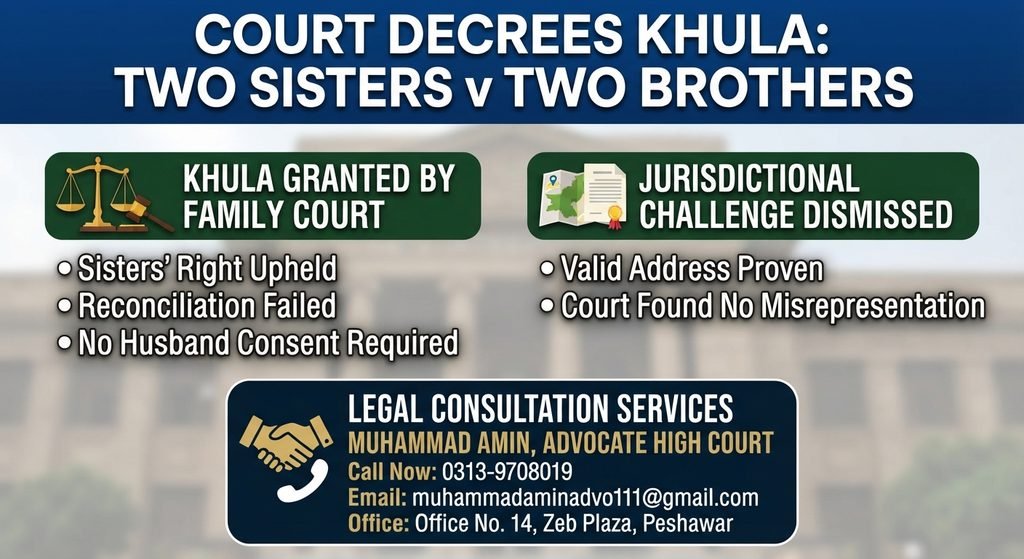
Introduction to Khula Without Husband Consent in Family Disputes
Khula without husband consent is a critical topic for many individuals navigating complicated marital disputes and seeking legal separation. Family disputes sometimes involve scenarios where close relatives marry within another family and face similar marital troubles. This specific case explores a unique legal battle where two sisters filed suits for dissolution of their marriages through khula without husband consent against two brothers. Lower family courts granted their requests and dissolved the marriages, but the husbands challenged those decisions. Having a reliable legal expert by your side makes the entire court process smooth and stress-free.
Addressing Jurisdictional Challenges in Family Court Cases
Husbands frequently challenge family lawsuits by arguing that wives filed cases in the wrong court jurisdiction. When dealing with khula without husband consent, opposing parties often raise technical objections regarding residential addresses. In this matter, the brothers claimed that the sisters provided a false residential address to manipulate court rules. However, courts require solid proof rather than simple accusations to throw out a case. The judges verified that the sisters actually lived at the stated address during the filing process, so the court dismissed the objection completely. Knowing how to handle these technical objections requires professional legal experience and careful handling.
Legal Principles Governing Khula Without Husband Consent
Key Legal Principle: When reconciliation efforts fail and the legal requirements are satisfied, the Family Court may consider a wife’s claim for khula even where the husband does not agree to the dissolution.
Husbands frequently argue that courts cannot grant khula without husband consent under any circumstances. However, legal frameworks and Shariat rulings state that a woman should never stay trapped in an oppressive or harmful marriage. When reconciliation efforts fail completely, courts possess full authority to grant khula without husband consent and without needing the husband’s agreement. This protects individual rights and ensures fairness under Islamic principles of justice.
Why Clients Trust Expert Legal Guidance for Family Matters
Family court litigation brings emotional weight and procedural complications that ordinary citizens find hard to manage alone. Managing matters related to khula without husband consent requires deep legal knowledge, strategic thinking, and careful attention to procedural details. Hiring a dedicated legal professional ensures that your petitions contain accurate facts, proper addresses, and strong legal grounds. Clients trust expert advocacy because it turns confusing court proceedings into clear victories. If you face similar family challenges or need reliable representation, professional help is just a phone call away.
Contact Information for Legal Consultation
Call Any TimeFor professional assistance with law services and related legal matters, contact:
Muhammad Amin, Advocate High Court
📞 Phone: 0313-9708019
📧 Email: muhammadaminadvo111@gmail.com
📍 Office: Office No. 14, Zaib Plaza, University Road, Tahkal Payan, Peshawar