1. Introduction to Getting Married in Peshawar
Completing a marriage in Peshawar involves both a religious ceremony and a legal process. Many couples, especially those seeking a private union, follow a straightforward path. This process ensures your Nikah in Peshawar is not only Islamically valid but also fully recognized by law. Understanding each step brings clarity and confidence, helping you start your marital life on a secure foundation.
2. The Legal and Religious Foundation
Every adult has a fundamental right to choose their life partner. Pakistani law protects this right. Therefore, your decision to pursue a legal marriage procedure in the city is supported by the constitution. Simultaneously, Islam encourages marriage as a sacred contract. When a couple meets the necessary Islamic conditions, their union is blessed and valid. So, the entire process for your wedding registration Peshawar aligns perfectly with both state law and religious teachings.
3. What You Need for a Valid Nikah
3.1. Basic Eligibility Requirements
The first requirement for any marriage in Peshawar is age. Both individuals must be 18 years or older. They must also be mentally sound and understand the commitment they are making. This rule applies equally to everyone and is the starting point for all legal procedures.
3.2. The Three Pillars of the Nikah Ceremony
The actual Nikah ceremony rests on three simple pillars. Firstly, one person must clearly propose. Secondly, the other person must clearly accept. Thirdly, two adult Muslim witnesses must observe this exchange. These witnesses are essential for validating the Nikah in Peshawar and providing future testimony if required.
3.3. The Question of Consent and Guardians
A very important legal point concerns consent. A woman aged 18 or above can marry whomever she chooses. She does not need permission from her father or any other guardian. Her own free and willing consent is the absolute key to a lawful legal marriage procedure.
4. The Step-by-Step Process in Peshawar
4.1. Performing the Nikah Ceremony
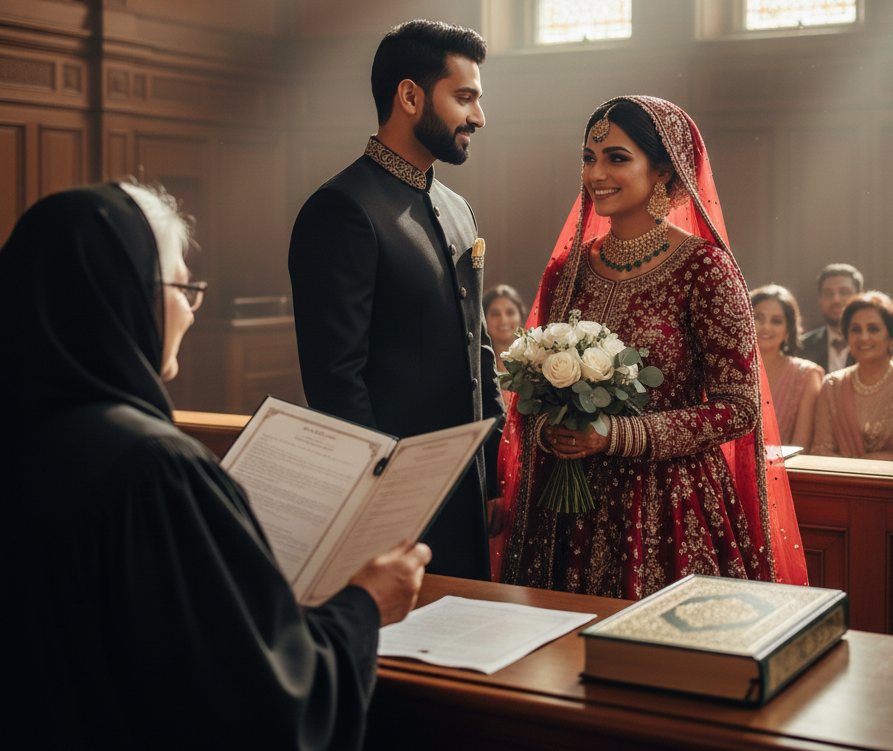
The journey begins with the Nikah. Couples often consult a lawyer for guidance. The lawyer assists in arranging a certified Nikah Khawan and reliable witnesses. In a simple gathering, the officiant conducts the Islamic vows, the couple agrees on the Haq Mehr, and everyone signs the initial Nikah Nama.
4.2. The Crucial Legal Registration
After the ceremony, registration makes your marriage official in the eyes of the state. You must submit the signed Nikah Nama to your local Union Council in Peshawar. Following this, you provide the same details to NADRA. Finally, NADRA issues your Marriage Registration Certificate (MRC), the ultimate proof of your wedding registration Peshawar.
4.3. Obtaining Protection from the Court
Sometimes, families disagree with the union. If you face any harassment or threats, the law offers protection. You can file a petition in the local court. Typically, the bride will give a formal statement before a judge, affirming her free will. This step secures your rights and prevents false legal cases.
5. Documents You Must Prepare
Getting your paperwork ready saves time. Both you and your partner need your original CNICs. If a CNIC is not ready, a B-Form will work to confirm age. Furthermore, if either person was married before, they must show proof that the previous marriage ended, such as a divorce certificate or death certificate.
6. Navigating Fees and Finding the Right Support
The government charges fixed, transparent fees for the Union Council and NADRA steps. However, costs for the Nikah officiant and your legal advisor can vary. Because this process is deeply personal, choosing a trustworthy and experienced lawyer in Peshawar is highly recommended for smooth and respectful assistance.
For professional guidance to complete your marriage in Peshawar, contact:
Muhammad Amin, Advocate
📞 Phone: 0313-9708019
📧 Email: muhammadaminadvo111@gmail.com