
Table of Contents
- Overview of the Narcotics Case Judgment in Pakistan
- Details of the Supreme Court Citation
- How the Police Recovered the Illegal Substances
- Key Legal Questions in Pakistan Drug Control Laws
- Arguments from the Appellant Lawyer
- How the Court Evaluated the Evidence
- Understanding Forensic Report Standards in Law
- Why the Defense Strategy Failed
- The Final Decision by the Supreme Court
- Important Legal Principles for Drug Cases
- Expert Legal Services in Peshawar
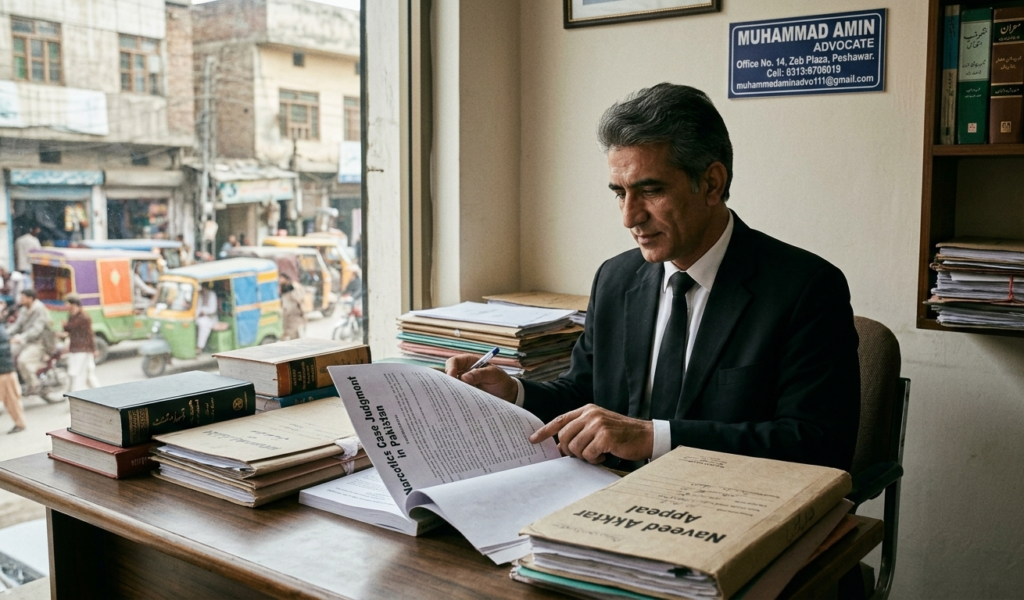
Overview of the Narcotics Case Judgment in Pakistan
The Supreme Court of Pakistan recently shared a very important decision about drug-related crimes. This Narcotics Case Judgment in Pakistan focuses on a man named Naveed Akhtar. The police charged him under the Control of Narcotic Substances Act of 1997. After a long legal battle, the highest court in the country decided to keep his punishment. This case helps everyone understand how judges look at evidence when the police find drugs at a person’s house.
Details of the Supreme Court Citation
Lawyers and students can find this specific case under the citation 2022 SCMR 1784. A panel of three judges, including Justice Manzoor Ahmad Malik, heard the arguments. The court officially decided the matter on September 22, 2020. This ruling serves as a guide for other CNSA Section 9c Procedures across the country. It shows that the court takes drug trafficking very seriously and follows strict rules to punish offenders.
How the Police Recovered the Illegal Substances
The story started when the police arrested Naveed Akhtar during a routine investigation. While the police questioned him, Naveed admitted that he hid more drugs inside his home. The officers followed him to his residence and found a large amount of charas. They discovered over six kilograms of the substance packed tightly in five separate packets. Each packet contained smaller portions that the police weighed carefully. This successful recovery led to a new criminal case against the suspect.
Key Legal Questions in Pakistan Drug Control Laws
The Supreme Court looked at several problems during the appeal process. Naveed’s legal team argued that the prosecution made many mistakes. They pointed out that a lower court already released Naveed in a different drug case. They also mentioned that one important witness did not come to court. Additionally, the lawyer claimed that the witnesses gave conflicting stories. These questions are common when someone challenges Illegal Substance Recovery Rules in Pakistan.
Arguments from the Appellant Lawyer
The lawyer for Naveed Akhtar tried to prove that the police acted unfairly. He stated that the missing witness actually had a criminal record himself. Because of this, the lawyer argued that the whole story about the drug recovery was a lie. He also told the judges that the High Court ignored the evidence Naveed provided for his defense. Finally, he claimed that the chemical testing lab did not follow the correct rules when checking the drugs.
How the Court Evaluated the Evidence
The Supreme Court judges reviewed every page of the police records. They looked at the statements from the officers who found the drugs. The court noticed that the main recovery officer gave a very clear and honest account of the events. Even though one witness was missing, the other witnesses provided enough information to prove the crime. The judges did not find any major differences in the stories that the police officers told in court.
Understanding Forensic Report Standards in Law
A very big part of any Narcotics Case Judgment in Pakistan is the chemical examiner’s report. The court checked the document marked as Exh-LPF very closely. This report confirmed that the brown substance was indeed charas. The judges found that the lab followed the exact Forensic Report Standards in Law that the court requires. Because the lab did its job correctly, the court accepted the report as solid proof against the accused man.
Why the Defense Strategy Failed
Naveed Akhtar claimed that the police set him up because they had bad intentions. However, he never provided any proof to back up these claims. He told the court he would give his own testimony, but he stayed silent during the actual trial. His other witnesses also failed to show that he was innocent. Since the prosecution had strong evidence and the defense had nothing but words, the court decided that Naveed was guilty of the crime.
The Final Decision by the Supreme Court
The Supreme Court found no reason to change the earlier decisions of the trial court or the High Court. The judges dismissed the Criminal Appeal Dismissal Pakistan and ordered Naveed to complete his prison sentence. He must serve over nine years in jail because of the large amount of drugs the police found. This final verdict shows that the court will protect the public from drug dealers whenever the prosecution brings clear evidence.
Important Legal Principles for Drug Cases
This judgment teaches us several important lessons about the law. First, if a person tells the police where they hid drugs, the court views that recovery as valid. Second, the case does not fail just because one witness cannot attend the trial. Third, the police must always follow the correct steps when sending samples to the lab. Lastly, if a defendant claims the police are lying, that defendant must show real proof to the judge.
Expert Legal Services in Peshawar
Legal issues involving drugs or civil disputes require a lawyer with a lot of experience. You need someone who knows the court system and can draft documents perfectly. Advocate Muhammad Amin has over seven years of experience helping clients in all types of courts across Pakistan. He provides honest advice and strong representation for criminal and family cases.
For professional assistance with law services and related legal matters, contact: call any time
Muhammad Amin, Advocate 📞 Phone: 0313-9708019 📧 Email: muhammadaminadvo111@gmail.com 📍 Office: Office No. 14, Zeb Plaza, University Road, Tahkal Payan, Peshawar