
Introduction to the Supreme Court Judgment on Negligence
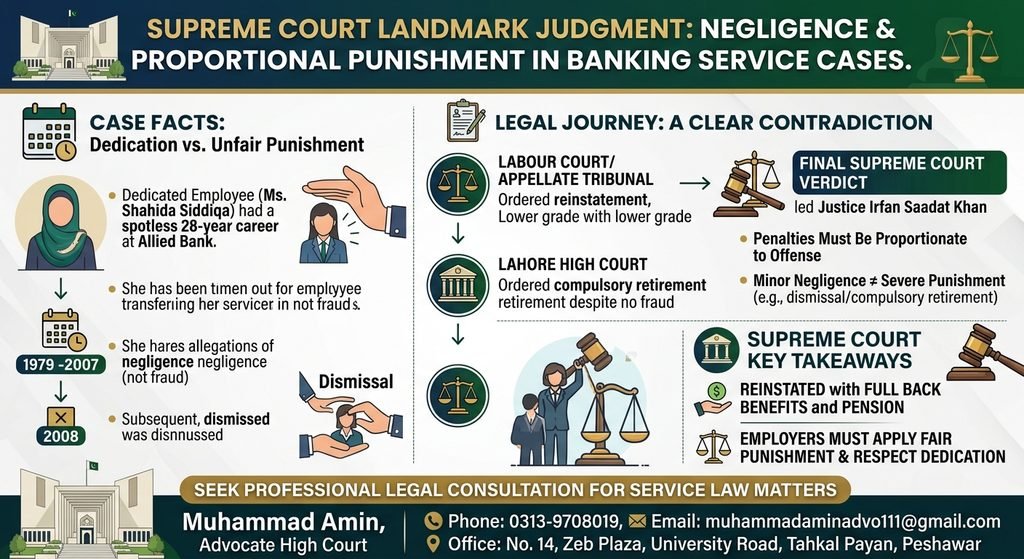
The Supreme Court of Pakistan recently delivered a landmark Supreme Court judgment on negligence that offers immense protection to employees facing harsh workplace penalties. Justice Irfan Saadat Khan headed the bench that evaluated whether simple oversight justifies severe punishments like dismissal or compulsory retirement. This legal protection for bank employees establishes that financial institutions cannot treat minor errors as intentional fraud. Consequently, this judgment provides a crucial legal shield for professionals who face unfair disciplinary actions after long years of service.
Detailed Background of the Legal Dispute
Mst. Shahida Siddiqa joined Allied Bank in 1979 and served the institution with dedication for twenty-eight years. The bank promoted her to Officer Grade-III in 1986 and later to Grade-II in 1995 due to her clean record. However, trouble began in 2007 when the bank transferred her to the Samundri Road Branch in Faisalabad. The management suspended her on allegations that she disclosed a secret code to a former manager who eventually committed fraud. Although the inquiry officer found her guilty of simple negligence rather than active fraud, the bank dismissed her from service in May 2008.
Decisions of the Lower Forums and High Court
The aggrieved employee challenged her dismissal in the Labour Court, which reviewed the facts and found no evidence of embezzlement. Therefore, the Labour Court ordered her reinstatement at a lower grade without back benefits, and the Appellate Tribunal upheld this decision. However, the Lahore High Court altered the outcome by ordering her compulsory retirement instead. The High Court acknowledged her long, spotless career, yet it still refused full reinstatement. This created a clear legal contradiction because the punishment did not match her actual level of responsibility.
Analysis by the Supreme Court of Pakistan
The Supreme Court examined the unfair compulsory retirement judgment and quickly identified fundamental flaws in the High Court’s reasoning. The apex court emphasized that penalties must always remain proportionate to the proven offense. Furthermore, the court highlighted that minor negligence without fraudulent intent never justifies severe measures like compulsory retirement. By citing historical precedents such as the Saifullah case, the judges reinforced the principle that disciplinary actions must aim to correct employees rather than destroy their careers.
Final Ruling and Key Takeaways
The Supreme Court partially allowed the appeal and set aside the order of the High Court. Instead, the Supreme Court verdict on work mistakes reinstated the employee at Grade-III with full back benefits and complete pension entitlements. Additionally, the court dismissed the bank’s cross-appeal and instructed both parties to pay their own legal costs. This decision firmly establishes that employers must apply fair punishment in service law and respect the long-standing dedication of their workforce.
Seek Professional Legal Consultation
Service law matters require expert legal guidance to protect your career, pension, and constitutional rights. If your employer unfairly penalizes you or threatens your job security, you need an experienced legal practitioner who understands complex employment regulations and Supreme Court precedents. Our law firm provides dedicated legal representation to ensure that courts protect your rights and restore your honor.
For professional assistance with law services and related legal matters, contact:
Call Any Time
Muhammad Amin, Advocate High Court
📞 Phone: 0313-9708019
📧 Email: muhammadaminadvo111@gmail.com
📍 Office: Office No. 14, Zeb Plaza, University Road, Tahkal Payan, Peshawar